The seven adverse experiences (scored 1 point each) were:
1. 2
weeks or longer in hospital
2. Parental
divorce
3. Parental
unemployment
4. A
frightening experience that was thought about for years after
5. Being
sent away from home for wrongdoing
6. Family
problems due to parental substance abuse
7. Physical
abuse by someone ‘close’
|
|
|
Many studies, including mine, have used retrospective
reports to assess the long-term consequences of previous events. However, many
other factors may bias the recall of such childhood events. In particular,
depressed mood may increase the likelihood of recall of negative experiences.
The aim of the study was to assess whether such factors are associated with
consistency in the reporting of childhood adverse experiences.
The sample comprised 7466 adults from Canada’s National
Population Health Survey who had in 1994/1995 (T1), and again in 2006/2007 (T2),
reported on seven adverse experiences from their childhood.
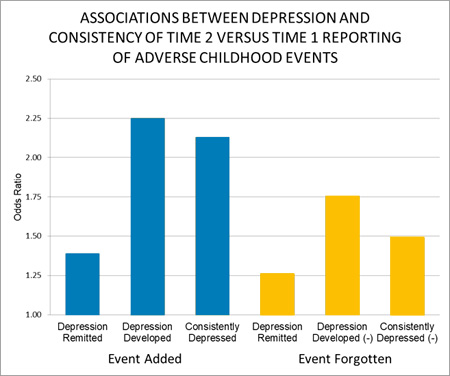
Accurate recall of childhood experiences is difficult; 39% showed
T1 vs. T2 inconsistency in their reports. The most important intervening
variable in our study proved to be depression. For example, the accompanying
graph shows that those who had developed
depression after T1 but before T2, had 2.25 the odds (likelihood) of
reporting an adverse event at T2 that, for some reason, was not reported at T1!
The same relationship was found for
increasing stress, but at a weaker level (odds ratios of 1.13 to 1.23). Furthermore,
the development of depression was also associated, but negatively (-) with
forgotten events – i.e. showing an odds ratio of -1.75, indicating a reduced likelihood of
‘forgetting’ a previously reported event.
Clearly, concurrent mental health factors can influence the
reporting of traumatic childhood experiences. Thus, in similarity to results
found in other research areas, studies that use retrospective reporting to
estimate associations between childhood adversity and adult outcomes associated
with mental health may be biased.
|
|
Source:
Colman
I, Kingsbury M, Garad Y, Zeng Y, Naicker K, Patten S, Jones PB, Wild
TC, Thompson AH. (2016). Consistency in adult reporting of adverse
childhood experiences. Psychological Medicine 46(03), 543-549.
|