| Emotional Disturbance Among 160 Children in Care | ||||||||
  |
This study of mental health
among child welfare wards was very similar to that just above, but with
a larger sample (160 children) and more extensive information. The main
finding was identical - these children are at very high risk and are
characterized by disorders that are enduring and difficult to
treat.
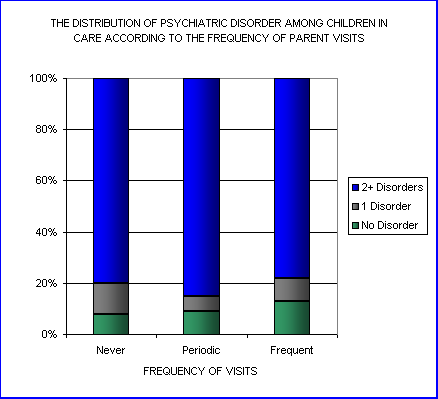
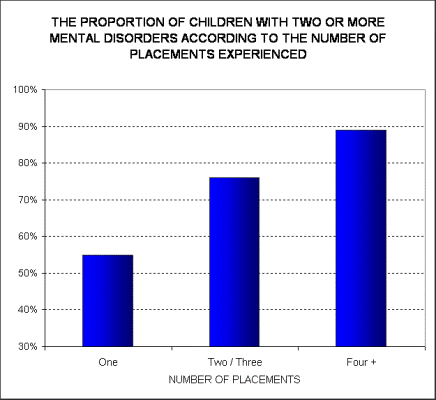
An additional item relating to the frequency of parental visits showed that although the frequency of visiting did have an association with mental disorder, most children in care show disturbance (2+ diagnoses) regardless of the frequency of visitation. The number of placements that a child experienced showed a strong association with mental disorder. As the lower graph shows, the greater the number of placements, the greater the proportion of disturbed children (i.e. 2+ disorders). This, however, does not tell us which is cause and which is effect. It seems likely that multiple moves are not good for a child's mental health, but it is just as likely that those who are most troubled when they enter care are less likely to find a stable living place. Nonetheless, this is an important finding, because it confirms the view that children in care are at extremely high risk for mental health problems (even those with a single placement show a 55% rate!). The highest risk group that I am aware of. Source: Thompson AH (1992). Emotional disturbance in a sample of children in the care of Child Welfare: A report to the Edmonton Region, Family and Social Services. Edmonton, Alberta Health. Click here for a full-text copy.  |
|||||||
|
||||||||