| Medical and Psychiatric Comorbidity Among Children | ||||||||
|
Background
The association of psychiatric disorders (PDs) with medical disorders
(MDs) has been insufficiently explored in children &
adolescents. The purpose here was to estimate medical &
psychiatric comorbidity in children with PDs & to assess
service use. |
and behavior. We used logistic regression to
assess medical comorbidity. Health care use was determined by comparing
the frequency of visits for MDs and PDs between children with PDs and
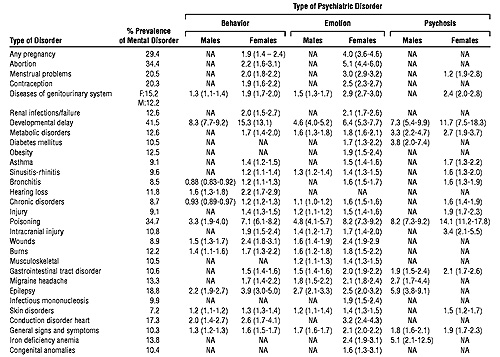
children without PDs. Setting We studied 406,640 children (50.6% male) 6-17 years old, living in Alberta, Canada, during the fiscal year April 1, 1995, through March 31, 1996. Results A PD was diagnosed in 32 214 (60.3% male) children. Psychiatric comorbidity was present in 13.6% of the children; comorbidity existed in all 3 psychiatric groups and peaked in postpubertal children. More girls than boys had significant medical comorbidity. Significant odds ratios (ORs) for girls varied from 1.2 (behavior and sinusitis, bronchitis, and chronic disorders; psychosis, and menstrual problems) to 15.3 (behavior and developmental delay). Among boys, the highest OR was seen with the combination of behavior and developmental delay (OR, 8.3) and psychosis and poisoning (OR, 8.2). With ORs ranging from 4.6 to 15.3, developmental delay consistently had high ORs for both sexes and all 3 types of PDs. Poisoning also had high ORs (3.3-14.1) with all 3 PDs and both sexes. Among girls, disorders associated with pregnancy and the genitourinary system had modest associations (OR, 1.9-2.2, for behavior) to moderate (OR, 2.5-4.0, for emotion). Children with PDs had significantly greater medical service usage than did children without PDs. Girls had greater medical health care usage than boys. Psychiatric service usage was similar for both sexes. Conclusions Medical/psychiatric comorbidity does exist in children. Girls are more commonly affected. Health care use is higher in children with PDs. |
|||||||
| Source: Spady DW, Schopflocher DP, Svenson LW, Thompson AH. (2005). Medical and psychiatric comorbidity and health care use among children 6 to 17 years old. Archives of Pediatric and Adolescent Medicine 159, 231-237. Click here for a copy | ||||||||
|
||||||||