| Does the Brain React More Quickly to Threatening Information? | ||||||||
|
|
It takes longer to recognize
words that are emotionally tinged. E. McGinnies proposed that this reflected unconscious inhibition of
unpleasant information. Critics noted that this might be due to the
relative infrequency of taboo words in print. Others suggested that we
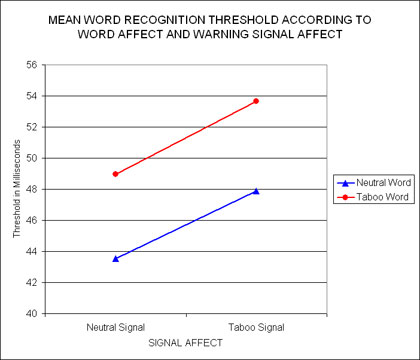
are "set" to see neutral words, and this set is broken when the unexpected taboo words appear. As a test, students were trained on the affective signal value of two symbols. One symbol served as a signal for taboo words and the other for neutral words. When words were preceded by the taboo signal a higher recognition threshold was obtained. This held true for both neutral words and for taboo words (see graph). That is, disrupting the set (e.g. a taboo signal followed by a neutral word) did not produce an effect that differed from the condition when the set was not disrupted (e.g. a taboo signal was followed by a taboo word). This casts doubt on the set disruption theory and provides some support for a perceptual defense explanation (or "negativity bias"). Furthermore, neuroscience research has indicated that threatening stimuli can be processed more quickly by the brain than other information, but only at a more basic (alarm no alarm) level. |
|||||||
| Source: Thompson AH, Dewar RE, Franken RE (1971). A test of the set disruption of perceptual defense. Canadian Journal of Psychology 25(3), 222-227. Click here to download a copy. | ||||||||
|
||||||||