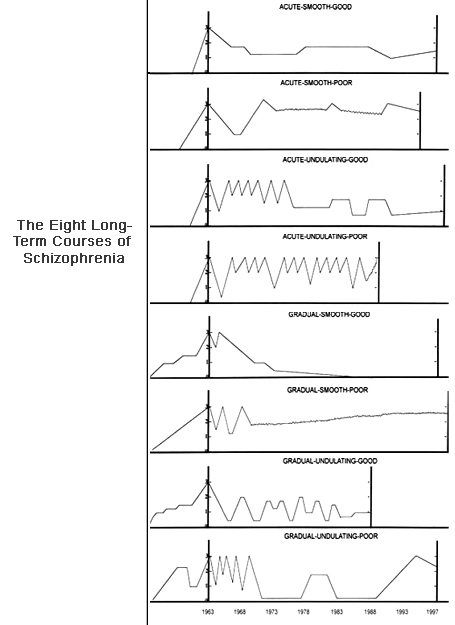
Several investigations of schizophrenia have used a 3-phase model to summarize the life-course of this
disorder (onset, course, and outcome). Onset here is classified as either acute
(e.g. < 6 months) or gradual (sometimes deemed “insidious” as it reflects slower deterioration and
poorer recovery). Course refers to the
post-onset years as being either undulating (highs and lows) or smooth. Outcome refers to the
last two years of data gathering.
The study population comprised 128 people who were first
admitted for schizophrenia to a mental hospital in Alberta in 1963
and followed until 1997 or death. Information was collected from the patients themselves, hospital
files, treatment records, and family members. A four-point rating system (0 to
3) was used to depict respondent information for each year when data were
collected. Thus, 3 = Hospitalization due
to mental illness; 2 = a psychotic episode verified by a professional (no
hospitalization); 1= some psychiatric symptoms and/or outpatient counselling;
and 0= Absence of psychiatric symptoms. These scores were collapsed to produce
the onset, course and outcome dichotomies described above, producing eight possible life-span classifications (2x2x2).
An example of each classification was drawn from our sample and
presented in the accompanying figure. Overall, we found that acute and
gradual
onsets were essentially equally (51% acute and 49% gradual), with
undulation dominating course at 64%, and outcomes being about
equal (52% being poor).
Our mathematical descriptions of onset, course,
and outcome produced profiles that did not closely match the results of
other
investigations, largely due to differing methods. Notably, the result
of our approach suggests that even for those with good eventual
outcomes, life is often very difficult.
.