| |
|
|
Projective tests were originally designed to measure our
subconscious thoughts - ones that were kept hidden from others and from
ourselves. Famously, tests were devised that required explanations of figures
seen in inkblots (the Rorschach) or in pictures involving human situations (the
Thematic Apperception Test). The idea is that the moods, fears, and beliefs
expressed by the person being tested are not so much about the test images, but
are actually their own inner thoughts revealed. In the day, I administered many
TATs (usually about 10 images) and I can tell you that it was fascinating - I
felt that I was getting a deep and privileged look unto the psyche of my
patients. The trouble is that the tests did not measure up under scientific
scrutiny. One issue is bias due to “social desirability”, i.e. a strong
tendency to respond in a way that will be viewed favourably by others.
A number of initiatives designed to make projective testing
more objective were met with varying success. In that era (50 years ago), a
fellow student, Don Ogston, and I checked out one of these - the Group
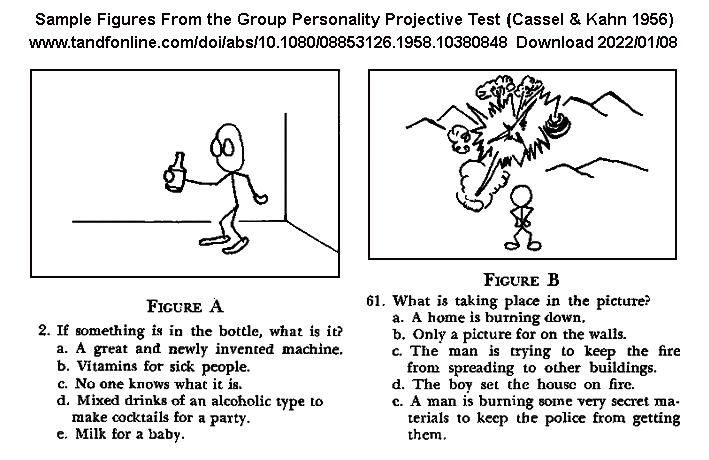
Personality Projective Test. This is a 90-item test, each of which contains a
stick-figure depiction of a life-situation plus 5 options that might explain
what is happening. Two examples are shown below. The options tap a number of
personal needs that include aggression, achievement, affiliation,
distrust, happiness, dejection, and more.
We were interested in social desirability bias, so we
tested two groups of university and nursing students. One group of 52 was
administered the GPPT in the normal way to reflect how each situation was interpreted.
The second group (n = 26) was asked to choose the most socially desirable
alternative (i.e. the "nicest" or most socially acceptable of the
five options. For each of the 90 items the perceived choices from Group 1 were compared
with the social desirability ratings provided by Group 2. These values were
then summed and then averaged across the 90 items. The resultant overall
correlation proved to be a strong 0.73, but it can perhaps be better
understood by squaring this number to obtain the proportion of variance
accounted for by social desirability. That is, 53% of the test result is due to
the wish of the subjects to be viewed favourably. At best, then,
less than half of the scoring (47%) is available to apply to the personality
factors supposedly measured by the test (plus mistakes!). This should hugely weaken
our confidence in this test. To some greater or lesser extent, this problem
applies to all self-report personality tests, particularly those that delve
into the mysterious subconscious. Be cautious.
|