| Does Distraction Actually Reduce Stuttering? | ||||||||
| |
 |
There are a
number of circumstances that may significantly alter stuttering
disfluencies temporarily. Examples are speaking in sync with a
metronome or when excited. This led many to adopt the hypothesis that
over-monitoring to our own speech might be the cause, and thus
distraction away from our own speech might be the answer. This was a
popular theory when I tested this a long time ago (in the seventies!)
by having a number of stutterers and a mathched group of nonstutterers
produce of speech samples which were recorded. Distraction was
produced by having the respondents follow a pathway on a rotating drum
with a wand that recorded on-track accuracy. The slow drum speed was
deemed to be "easy" and a speeded up version was rated as "difficult".
Trained raters scored each respondent's speech for disfluencies in eack
distraction condition. The
results showed that, unsurprisingly, the stutterers produced more
disfluencies than the nonstutterers with a ratio above 6 to 1, but
neither group showed any statistically significant difference due to
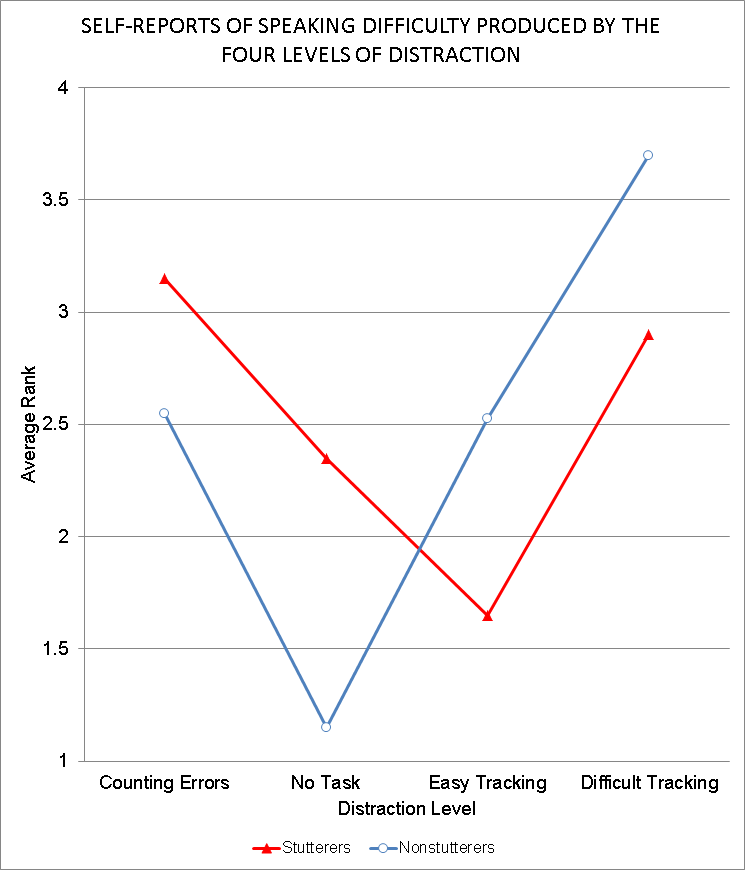
the level of distraction! However, even though actual performance
accuracy did not vary across conditions, the stutterers rated the
difficulty of these conditions in accord with the distraction theory.
That is, the stutterers found it easiest to speak in the easy tracking
condition, while the nonstutterers found it easier to speak in the
condition that had no distraction effect (positive or negative) at all.
 |
||||||
|
Source:
Thompson AH (1985). A test of the distraction explanation of disfluency
modification in stuttering. Journal of Fluency Disorders 10,
35-50. Click here for a copy.
|
||||||||
|
||||||||