| Relative Age and Little League Baseball | |||
 |
In an attempt to understand
the very small relative age effect among Major League baseball players,
we studied Little League players
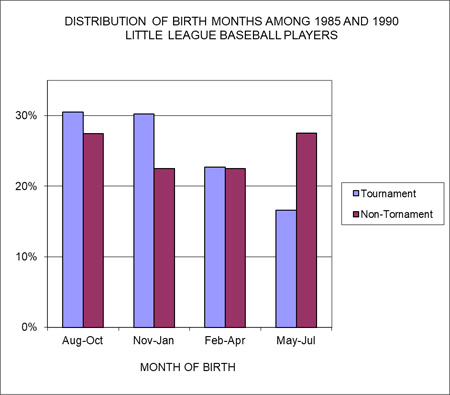
where the effect was presumed to be rooted. Our analysis of team rosters did not reflect the presence of an effect of any significance. It was only when we considered those selected for post-season play did an effect emerge. But as the figure shows, the differing trends for these two groups showed neither the magnitude nor the clarity found in other sports . This weak effect among professional baseball players was thus hypothesized to be a natural consequence of its weak development during the formative years of Little League. This, in turn, might be explained by the size of the age-range used by Little League teams - often 4 to 5 years - much larger than that found in other team sports. Thus, all budding baseball players are at a disadvantage when they begin, and all will have an advantage in later years. This may neutralize some of the mechanisms that might be "in play" in other sports. |
||
| Source. Thompson AH, Barnsley RH, Stebelsky G (1992). Baseball performance and the relative age effect: Does Little League neutralize birth date selection bias? Nine, 1(1), 19-30 (for a copy click here) | |||
| Relative Age Menu |
|||