| Relative Age & Ranking in Minor Hockey | ||||||||
|
|
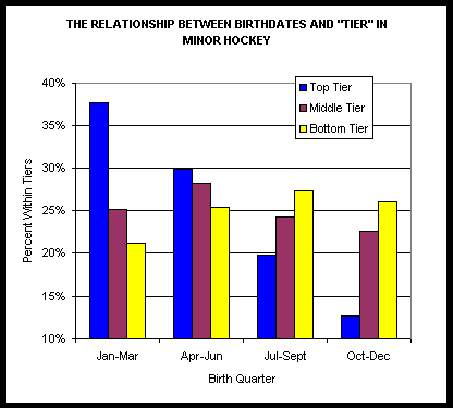
Minor hockey organizations often divide age
groupings up into "sub-leagues" (tiers) on the basis of skill. If
relative age has an effect, then children who are older when they first
play organized hockey would be more likely to make top tier teams,
while the younger players should gravitate to the bottom tier. The
distribution of birthdates of about 8,000 Edmonton minor-league hockey
players (9-15 yrs.) is shown on the left. As predicted, top tier
players did show a strong relative age effect, and bottom tier players
showed a reverse relative age effect. An important finding was that those born in the latter part of the year were more likely to "drop out" of hockey altogether. The data provide support for relative age theory, & suggest that ongoing relative age disadvantage may demoralize some children and cause them to withdraw from competitive activity. |
|||||||
| Source: Barnsley RH, Thompson AH (1988). Birthdate and success in minor hockey: The key to the N.H.L. Canadian Journal of Behavioral Science 20, 167-176. Click here for a copy. | ||||||||
|
||||||||