| Relative Age and World Class Soccer | ||||||||
 |
At the time of data collection for this study,
the cutoff date for entry into organized childrens soccer was
August 1st. Thus, those beginning footballers who were born in August
would have been close to a year older than those in their age-group who
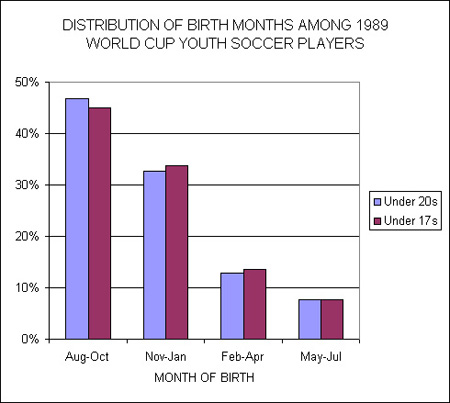
were born the following July. As the accompanying figure shows, the
relative age effect had done its work while these boys were still
teen-agers. Those who were able to play at the World level have been
chosen in large part by an accident of birth - whether it be for the
under age 20 tournament or for the under 17s . Nearly half were born in
the first three months of the football eligibility year, while less
than seven percent were born in the final quarter! A relative age
effect was also found for the players involved in the World Cup of
Football in 1990, but it was not as strong. This result is similar to that found for hockey (with perhaps an even stronger effect!). The fact that the cutoff here was August, in contrast to January for hockey, suggests that seasonal/climatic influences associated with the time of birth or gestation are irrelevant to the effect. |
|||||||
| Source: Barnsley RH, Thompson AH, Legault P (1992). Family planning: Football style, the relative age effect in football. International Review for the Sociology of Sport 27(1), 77-88. Click here for a copy | ||||||||
|
||||||||