| Unintentional
and Intentional Injuries 1. A Common Bond? |
|||
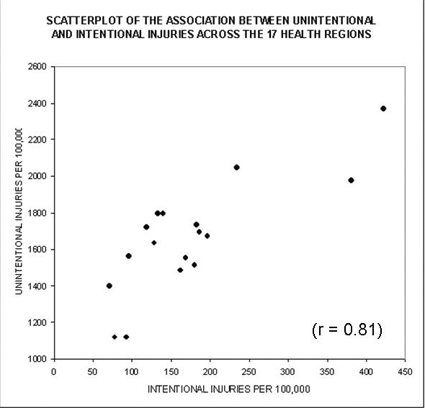 |
The growing practice of including suicide and interpersonal violence under the injury control umbrella has produced some controversy. The present study was designed to determine whether there might be an empirical basis for this from an ecological point of view by examining the associations among unintentional and intentional injuries across geographically defined health regions. The study took place in the Province of Alberta, Canada, where health services were delivered to a population of 2.96 million persons in 1999 through 17 regional health authorities. The accompanying figure shows intentional injury rates (suicide attempts and assaults) plotted against unintentional injury rates (all others) for each of the 17 regions. The scatterplot clearly shows that regions that are high on one form of injury tend to be high on the other. Furthermore, a factor analysis showed that nearly all causes of injury-hospitalization loaded on a single factor. It was not possible to produce separate factors for intentional and unintentional injuries. These findings indicate that there is an empirical basis for the view that intentional and unintentional injuries belong under the same conceptual umbrella, at least at the ecological level. | ||
| Source: Thompson AH, Borden K, Belton KL (2004). Intentional and unintentional injuries across health regions in Alberta, Canada: An implication for policy. Crisis 25(4), 156-160. Click here to download a copy (85 kb). | |||
| Suicide Related Menu |
|||