|
|
|
The
sister posting to this one, “Unintentional and
Intentional Injuries: 1.” Is based on the same study and reflects the
primary purpose
of that investigation (to determine whether intentional and
unintentional
injuries are related). The findings reported here were serendipitous
and
uncovered the surprising involvement of
health system errors.
While there was no consistent international
format for
grouping injury causes at the time of our study, the Alberta Center for
Injury
Control & Research, in partnership with Alberta Health
& Wellness, had
developed standard injury groupings for their use. The 25 injury
groupings were
based on the International Classification of Diseases, Version 9,
external
causes of injury and were applied here to all hospitalizations due to
injury in
Alberta
during calendar year 1999.
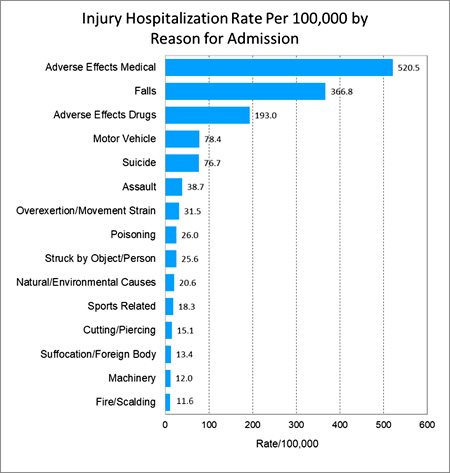
The accompanying figure shows the 15 most
relevant injury
admissions expressed as the Provincial rate per 100,000 persons.
Excluded were
classifications that were not specific/vague (i.e. Other Transportation
Related,
Late Effects of Injury, Unspecified Cause, and Other Classifiable
Injury), as
well as those showing a very low rate (<10 per 100,000; Bike -
Non-Traffic, Undetermined
Intent, Pedestrian - Non Traffic, Drowning, Firearm (unintentional),
and legal
intervention). The excluded groups made up a total of only 8.3% of all
injury
hospitalizations.
Across all causes the resulting distribution is
highly
skewed with three categories (medical misadventures,
falls, and drug effects)
making up 68% of all injury admissions. Notably, medical misadventures
and drug
effects can be classified as medical errors that, together, were deemed
to be
causal in 45% of all the Provincial injury admissions in a one-year
period.
Shocking as this finding may seem, it corresponds with findings from
other
jurisdictions and has led to increasing attention to safety measures in
hospitals in, at least, Canada and the United States.
|