| Mental
Illness and Social Problems Across Canada |
|||
 |
The 2002 Canadian Community Health Survey (CCHS)
allowed the determination of provincial 12-month prevalence rates for
selected psychiatric
disorders and thus made it possible to assess the association between
these disorders and the Canadian Social Problem Index (SPI; a composite
of rates for crime, suicide, alcoholism, unemployment and divorce).
Rates for depression, mania, panic, social phobia, and agoraphobia were
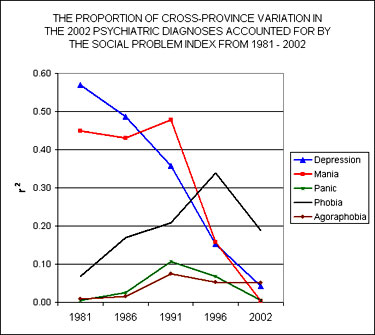
compared with the 2002 SPI across provinces. The results showed that the SPI had maintained its tendency to increase from east to west in Canada, a trend reflected by depression and mania. The psychiatric disorders did not show strong correlations with the SPI in 2002, but depression and mania did show relatively strong associations with SPI values from earlier years (see Figure). This suggests that the extent of social problem behaviour may be due to mental illness levels several years earlier. High to low ratios across provinces for individual social problems were elevated (averaging 5X), and the results were essentially the same for psychiatric diagnoses. The association between mental disorders and social problem behaviour across provinces found here suggest that separate per capita allocation of funding for mental health and social programs may not be appropriate. |
||
| Source: Thompson AH. (2005). Variations in the Prevalence of Psychiatric Disorders and Social Problems across Canadian Provinces. Canadian Journal of Psychiatry 50 (Canadian Academy of Psychiatric Epidemiology Special Issue), 637-642. | |||
| Social Problems Menu |
|||