| The Suicidal
Process: Severity and Age of Onset |
||||||||
| |
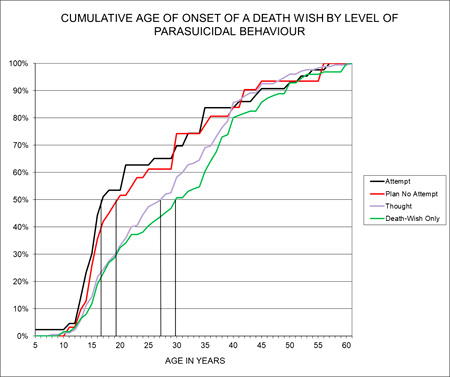 |
The concept of the suicidal process implies a progression from behaviour
of relatively low intent to completed suicide. Evidence from the literature has
given rise to the speculation that the age of onset of an early form of the
suicidal process may be associated with the ultimate seriousness of suicidal
behaviour. This study tested the hypothesis that early onset of
the first stage of the suicidal process, a wish to die, is associated with
increases in the ultimate position along the suicidal process dimension.  |
||||||
|
Thompson AH, Dewa CS,
Phare S. (2012). The suicidal process: Age of onset and severity of suicidal behaviour.
Social Psychiatry and Psychiatric Epidemiology 47, 1263-1269. Click here
for a copy. |
||||||||
|
||||||||