| The Suicidal Process and Self-Esteem |
||||||||
| |
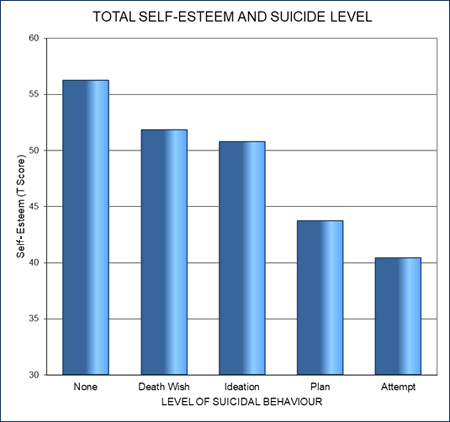 |
It
has not been made clear whether or not self-esteem is associated with the severity
of suicidal behavior. To examine this notion, the association between
responses to a self-esteem inventory and a theoretical gradient of suicidal
intent, called the suicidal process, was examined. The suicidal process describes increasing levels of suicidal
intent as beginning with thoughts of death (death wishes) and moving through ideation
(thoughts of taking one’s own life), making a suicide plan, and then actually
making a suicide attempt.  |
||||||
|
Source: Thompson AH (2010). The suicidal process and self-esteem.
Crisis: The Journal of Crisis Intervention and Suicide Prevention 31(6),
311-316 (Note: the data were collected in the nineteen-eighties, but not published until 1910). Click here for a copy. |
||||||||
|
||||||||