| Self-Regulating Systems | |||
| Many difficulties arise from
the present methods of service delivery for children. Self-regulating
service delivery has
the potential to address these fundamental difficulties and to bring
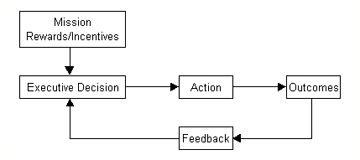
benefits for all children. The system has four components. I. A set of
outcome indicators that reflect the wellbeing of children. II. A
regular feedback process to ensure that relevant information gets to
those who influence or manage services. III. The
use of powerful incentives that are contingent upon the outcomes. This
reduces the influence of "deflecting" factors and enhances the focus on
beneficial outcomes. IV. Executive decision-making capacity to keep all
relevant parties focussed on the outcomes. Self-regulation works like
home heat control. The purpose is to provide comfortable warmth. If
room
temperature is not high enough, the action taken is to turn on the
furnace. The outcome of this is measured by a thermometer and fed back
to the executive centre (thermostat). The function of the executive
centre is to interpret the feedback and make a decision (turn the
furnace off or leave it on). Steps for children's services: 1. A
mission for the system of care is established, with
indicators that reflect the Mission. 2. Measurements are taken at
regular intervals, with data transformed into meaningful outcome
indicators. 3. Regular progress reports on the well-being of children
are provided to all
interested parties.
|
4. Rewards for
specific achievements are given to organizations, communities or
individuals in accordance with the achievement of outcome goals. The
system will flounder without strong rewards for
achievement, and the nature of these rewards will reflect the
importance of children in our society. 5. The executive arm of service
agencies will use the outcome indicators to evaluate progress toward
goals and, in doing so, will note that some important goals cannot be
achieved without cooperative action with others. Their process will
help them decide which actions and collaborations will be adopted to
lead to improved outcomes in the following years. 6. The cycle will
repeat itself, with each cycle will bringing improvement in the mental
health of children; our future adults. All will benefit.
 |
||
| Source (Health Canada):
Thompson G, Junek W, Boyd L, Kluger J, LeBlanc C, Russell T (1999).
Celebrating success: A self-regulating service delivery system for
children and youth. Ottawa: Health Canada. Click here
for a downloadable copy of the report. Source (Journal): Junek RW, Thompson AH (1999). Self-regulating service delivery systems: A model for children and youth at risk. The Journal of Behavioral Health Services and Research 26(1), 64-79. |
|||
| Health Systems Menu |
|||