| Self-Report Tests
of Work Productivity Show Low Levels of Commonality |
||||||||
|
|
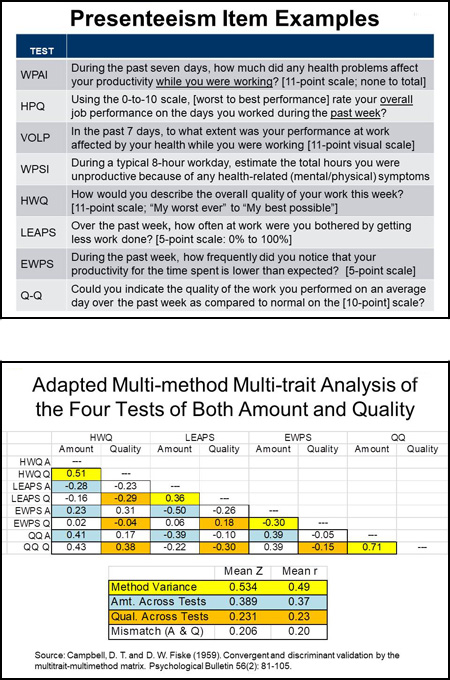
Presenteeism refers to decreased productivity or below-normal work quality when physically present at work. It is
thought to be responsible for large economic costs. The measurement of such
costs frequently involves the use of self-report
instruments which have a number of weaknesses; a tendency for people to over-rate their own
performances, imprecision in the definition of productivity, and potential biases inherent to the structure of each
testing instrument. Furthermore, the integrity of these instruments has
not been demonstrated.
The
results suggest that presenteeism tests
do not accurately assess work performance, and seem to tell us more
about the
nature of the test than that of the constructs they were designed to
measure. Attention needs to be given to test improvement in the context
of criterion
validity assessment. 
|
|||||||
|
Thompson AH, Waye A (online
in press). Agreement among the productivity components
of eight presenteeism tests in a sample of health care workers. Value in
Health. DOI: http://dx.doi.org/10.1016/j.jval.2017.10.014 |
||||||||
|
||||||||