| A Mental Health
Promotion Workshop for Senior Worksite Staff |
||||||||
|
When an Alberta firm was fined for an environmental offence involving mental health issues, the presiding judge invoked a “creative sentencing” approach. Three-quarters of the fine was awarded to the Institute of Health Economics to undertake and evaluate a mental health promotion project relevant to the improvement of conditions in Alberta workplaces. 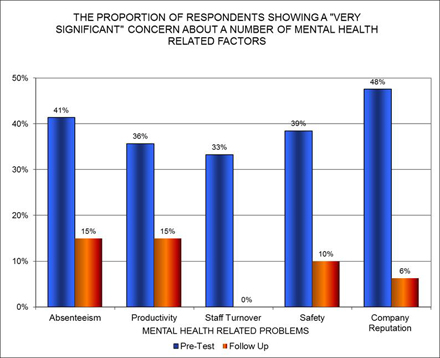 As an example, one of the findings is shown in the graph above. This reflects considerable original concern about the problems potentially caused by mental health issues, but with fears considerably allayed at follow-up. There is no obvious explanation for this, but a reasonable hypothesis is that the workshop increased sensitivity and that this dispelled some of the fears that have been shown to be associated with mental illness.
|
The Canadian Mental Health Association was commissioned to present training comprising two days, one month apart, for senior workplace staff. Sessions dealt with the recognition of mental health problems, connecting with troubled employees, management influences, and suggested worksite policy and procedural changes. Participant views were captured in a questionnaire that was administered three times - before and after the workshop sessions and again at follow-up (3 – 5 months later). Session I was successfully delivered to 35
persons, while 28
attended day 2. The findings across our three evaluation components
showed
strong evidence for workshop quality. All attendees agreed (or strongly
agreed)
that they would recommend the training to others. Notably pre-workshop
confidence in the ability to locate help for someone with a mental
illness was
fairly high and improved significantly after training. However,
confidence in
the ability to actually talk to a mentally ill employee did not change,
nor did
confidence in gaining the engagement of senior management (although,
initial
levels were relatively high). Respondents improved on existing
strengths on
matching symptoms to diagnoses and understanding the relationship with
addictive behaviours. Awareness of the influence of disability was
initially
low, with significant improvement, and attribution of cause showed no
change
after training, but levels were initially very high and appropriate.
Finally,
there were indicators that some positive developments were initiated in
the
workplaces of the attendees, but these had not been extensive, likely
due to our
short follow-up period. Five of the respondents had left their
employment
situation and could not, of course, provide a follow-up
report.
|
|||||||
|
Source: Thompson AH, Jacobs P, Moffatt J, Waye A. Delivery and evaluation of a mental health promotion intervention for Alberta workplace supervisors and managers. Edmonton AB: Institute of Health Economics, 2013. Click here for a copy of the full report. |
||||||||
|
||||||||
