| Relative Age and Major League Baseball | |||
 |
The
relative age effect has been shown to have a large influence on most
competitive team sports where children have been assigned to youth
leagues according to age. This has not been well-studied in baseball,
thus the current investigation of Major League players in North
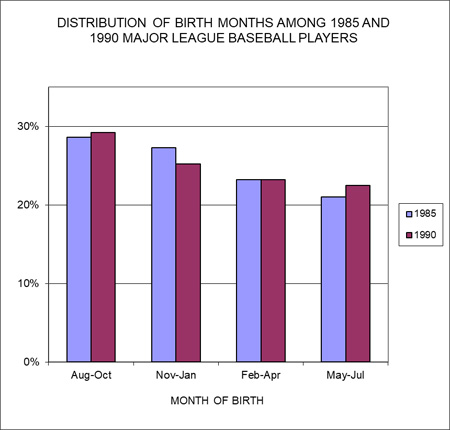
America. The records of 837 Major League baseball players were examined in order to determine whether the Little League eligibility criterion, based on the month of birth, affected participation at the professional level. The graph on the left shows the influence of the relative age effect among Major League Baseball players. Note that a larger number of players were born in the first three months of the baseball eligibility year (beginning on August 1st), with the numbers tapering off toward the end of the year. However, the magnitude of the effect is much lower than that found among other sports like soccer and hockey (see the soccer results for a graph depicted on a similar scale). This weak effect among professional baseball players was thus hypothesized to be a consequence of effects during the formative years of Little League, thus pointing to our next study - an examination of Little League. |
||
| Source. Thompson AH, Barnsley RH, Stebelsky G (1991). Born to play ball: The relative age effect and Major League Baseball. Sociology of Sport Journal, 8, 146-151 (for a copy click here). | |||
| Relative Age Menu |
|||